
Acute Liver Failure
What Is Acute Liver Failure?
Acute liver failure is a rare emergency in which a previously healthy liver fails within days to a few weeks. Three findings define it, and all three must be present: a sudden derangement of liver blood tests, coagulopathy arising from the liver itself (INR of 1.5 or higher), and altered consciousness — hepatic encephalopathy — in a person with no known chronic liver disease. Drop any one of them and the diagnosis is something else.
That definition is not academic hair-splitting. It decides where the patient sleeps tonight. Jaundice alone is a ward problem; jaundice with confusion is an ICU problem, and often a transplant problem. The interval between the two can be under seventy-two hours.
Because acute liver failure is uncommon, it is routinely missed at first contact. Most of these patients are seen initially for “viral fever with jaundice”, given supportive advice, and told to repeat their liver function tests in a week. Some of them do not have a week.
I am Dr Chetan Kalal, DM Hepatologist and Liver Transplant Physician at Gleneagles Hospital, Parel. Acute and acute-on-chronic liver failure has been the spine of my clinical and research work since my DM training at ILBS, New Delhi under Prof S. K. Sarin.
What Causes Acute Liver Failure in India?
Western guidance opens with paracetamol. India does not follow that script, and working an Indian patient up from a British algorithm wastes the first twelve hours.
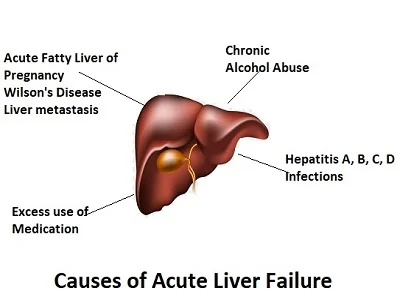
Acute viral hepatitis is our commonest cause. Hepatitis A and hepatitis E account for the majority of acute liver failure across India and much of Asia, while paracetamol overdose dominates in the United Kingdom and United States — a regional difference the EASL guidelines set out explicitly. Practically, that means IgM anti-HAV and IgM anti-HEV belong in the first blood draw, not the second.
Hepatitis E in pregnancy is its own emergency. Pregnant women with hepatitis E have markedly worse maternal and fetal outcomes than other patients, driven by a distinct immune and metabolic response to the virus. A jaundiced woman in the second or third trimester needs a hepatology assessment the same day, not an obstetric review alone.
Drug-induced liver injury is the second large group. Anti-tuberculosis therapy — isoniazid, rifampicin, pyrazinamide — is the one I see most often, which matters in a country that treats more tuberculosis than any other. Antiepileptics, antiretrovirals and high-dose paracetamol follow. So do herbal, Ayurvedic and “liver-cleansing” preparations, which patients almost never volunteer unless asked directly. Ask directly.
Less common but important, and all of them treatable if named early: an acute presentation of autoimmune hepatitis; Wilson disease in a patient under 40 with haemolysis and a strikingly low alkaline phosphatase relative to bilirubin; Budd–Chiari syndrome and other vascular causes; ischaemic hepatitis following shock or severe sepsis; and mushroom poisoning. In a real proportion of patients no cause is ever found despite a complete workup — indeterminate acute liver failure, which behaves worse than a cause you can name and treat.
Acute Liver Failure Is Not Acute-on-Chronic Liver Failure
This is the commonest diagnostic error I correct in referrals, and it changes everything downstream.
Acute liver failure happens in a liver that was healthy last month. Acute-on-chronic liver failure (ACLF) happens in a liver that already carries chronic disease — often undiagnosed until that admission — and then takes a fresh insult: alcohol, a hepatitis B flare, a drug, sepsis. The APASL definition requires jaundice and coagulopathy followed within four weeks by ascites, encephalopathy or both, in a patient with known or previously unrecognised chronic liver disease.
Same jaundice. Same confusion. Entirely different prognosis, different transplant timing, and a different role for plasma exchange and steroids. I was among the contributors to the APASL 2019 consensus update on ACLF, and the point the working group kept returning to is that these two syndromes are conflated at the bedside more often than any other pair in hepatology.
The separator is not clever. It is an ultrasound, a platelet count and a proper history. A coarse liver, an enlarged spleen, a low platelet count, or old imaging showing cirrhosis moves the patient out of the acute liver failure box entirely. Read more about acute-on-chronic liver failure here.
Symptoms and Warning Signs
Signs that a jaundiced patient is slipping into liver failure:
Yellowing of the skin and eyes (jaundice) — usually the first sign noticed
Confusion, disorientation or unusual drowsiness (hepatic encephalopathy)
A reversed sleep–wake cycle — sleeping through the day, restless at night
Bruising easily, bleeding gums, or nosebleeds
Persistent nausea and vomiting
Pain or tenderness in the upper right abdomen
Abdominal swelling (ascites)
A sweetish, musty odour on the breath (fetor hepaticus)
A flapping tremor of the outstretched hands (asterixis)
Profound tiredness and loss of appetite that worsens by the day
How Acute Liver Failure Is Diagnosed
The workup runs in parallel, not in sequence, because the diagnosis and the prognosis are being established at the same time.
First hour: INR and prothrombin time, complete blood count, liver and renal function, electrolytes, glucose, arterial blood gas with lactate, blood group, and ammonia. Hypoglycaemia is common here and easy to overlook.
Cause-finding: IgM anti-HAV, IgM anti-HEV, HBsAg with IgM anti-HBc, a paracetamol level where the history allows, autoimmune markers (ANA, ASMA, IgG), ceruloplasmin and 24-hour urinary copper in anyone under 40, and a pregnancy test in women of childbearing age.
Imaging: ultrasound with Doppler of the hepatic and portal veins. That scan does two jobs — it looks for Budd–Chiari syndrome, and it looks for the chronic liver disease that would reclassify the patient as ACLF. CT of the head if encephalopathy reaches grade III or IV, or if the presentation is atypical.
Then repeat the INR. The most useful test on day one is not a scan. It is a second INR six to twelve hours after the first. A rising INR in a patient whose bilirubin is still climbing is the trajectory that decides transplant referral — and it is invisible on a single reading.
How Acute Liver Failure Is Treated
Management has three simultaneous arms: treat the cause, protect the brain, and decide about transplantation early enough for the decision to matter.
Cause-specific therapy. N-acetylcysteine for paracetamol toxicity, started on a suggestive history rather than waiting for levels. In non-paracetamol acute liver failure, intravenous NAC improved transplant-free survival in patients with early encephalopathy — 52% versus 30% in coma grades I–II in the pivotal randomised trial — with no benefit shown in grades III–IV. Current ACG guidance reflects exactly that: give it early or not at all. Beyond that, nucleos(t)ide analogues for hepatitis B, corticosteroids for autoimmune hepatitis where the biopsy supports it, and delivery for pregnancy-associated liver failure.
Protecting the brain. Cerebral oedema, not the liver itself, is what kills a large share of these patients. Nurse head-up at 30 degrees, avoid hypotonic fluids, keep serum sodium in the high-normal range, treat agitation rather than sedating heavily, and escalate early — hypertonic saline and intubation as grades advance. Lactulose is far less central here than it is in cirrhosis; do not let it substitute for escalation.
The quiet decisions that determine outcome: tight glucose control, active infection surveillance with a low threshold for empirical antibiotics, continuous renal replacement therapy for ammonia clearance and acidosis rather than for urea alone, and — the one that gets argued about on every round — not correcting the INR with fresh frozen plasma simply because the number looks alarming. Correcting it blindly discards the most useful prognostic marker available and adds volume the patient does not need.
When Is a Liver Transplant Needed?
Not every patient with acute liver failure needs a transplant, and not every patient who needs one reaches a centre in time. The difference between those two groups is almost always referral timing.
The King’s College criteria, published from the King’s College Hospital liver unit in 1989 and still the most widely used prognostic tool in this setting, identify patients unlikely to survive on medical management alone:
- Paracetamol-related: arterial pH below 7.30 after adequate fluid resuscitation; or all three of INR above 6.5, creatinine above 3.4 mg/dL, and grade III–IV encephalopathy.
- Non-paracetamol: INR above 6.5 on its own; or any three of — age under 10 or over 40 years, an unfavourable aetiology (drug reaction, or non-A non-B hepatitis), a jaundice-to-encephalopathy interval longer than seven days, INR above 3.5, and bilirubin above 17.5 mg/dL.
Read that list once more and notice what it means. By the time a patient satisfies it, the window is nearly shut. The criteria are a listing tool, not a referral trigger. The referral trigger is encephalopathy of any grade in a patient with a rising INR. Telephone the transplant centre at that point, not when the criteria are met.
Where transplantation is indicated, living donor liver transplantation is usually the realistic route in India, given deceased-donor waiting times. That conversation with the family belongs on day one, not day four. More on liver transplant assessment and outcomes.
When to Seek Emergency Help
Take the patient to a hospital with hepatology and intensive care on site — the same day, not the next morning — if jaundice is accompanied by any of the following:
- Confusion, disorientation, unusual drowsiness, or a reversed sleep pattern
- Bleeding gums, nosebleeds, or bruising without injury
- Persistent vomiting, or inability to keep fluids down
- Reduced urine output
- Pregnancy at any stage
- Current anti-tuberculosis treatment, a recently started drug, or any herbal or Ayurvedic preparation
Bring the medicine strips. Every bottle, including the Ayurvedic ones. The label frequently makes the diagnosis faster than the blood tests do.
Dr Kalal consults at Gleneagles Hospital, 35 Dr Ernest Borges Road, Parel, Mumbai 400012 — Monday, Wednesday, Thursday and Friday, 11 AM to 5 PM, and Saturday 10 AM to 1 PM. For an urgent liver opinion or a second opinion on a patient already admitted elsewhere, contact the clinic here. In an emergency, go to the nearest emergency department first and arrange the hepatology referral from there.
Frequently Asked Questions About Acute Liver Failure
Is acute liver failure reversible?
Often, yes. The liver has a genuine capacity to regenerate, and patients with hepatitis A, paracetamol toxicity or a withdrawn drug can recover completely on intensive supportive care without a transplant. Outcome depends heavily on the cause and on the grade of encephalopathy at presentation, which is precisely why the first twenty-four hours are worth so much.
How quickly does acute liver failure progress?
Days to weeks by definition, but the deterioration is rarely linear. A patient can look stable at 9 AM and be encephalopathic by evening. Serial INR measurements and repeated neurological assessment matter more than any single scan.
What is the difference between acute liver failure and acute-on-chronic liver failure?
Acute liver failure occurs in a liver with no pre-existing disease. Acute-on-chronic liver failure occurs in a liver already damaged by cirrhosis, hepatitis B, alcohol or fatty liver disease that then takes a fresh insult. They look similar at the bedside and are managed very differently.
Does every patient with acute liver failure need a liver transplant?
No. A substantial proportion recover on medical management alone. Transplantation is for the group whose prognostic markers — INR, bilirubin, creatinine, arterial pH and encephalopathy grade — indicate they will not survive without it. The whole skill lies in identifying that group early enough.
Is jaundice always a sign of liver failure?
No, and most jaundice is not. Jaundice becomes an emergency when confusion, bleeding or a rising INR joins it. Those three are what to act on.
Which doctor treats acute liver failure in Mumbai?
A hepatologist working alongside a transplant unit and an intensive care team — not a general physician alone, because the decisions involve transplant timing. Dr Chetan Kalal is a DM Hepatologist and Liver Transplant Physician at Gleneagles Hospital, Parel, and has been part of 1,000+ liver transplants, providing medical care before, during and after transplantation.
References and Clinical Review
This page is written and clinically reviewed by Dr Chetan Kalal, MBBS, MD, DM (Hepatology), Associate Director — Hepatology and Transplant Medicine, Gleneagles Hospital, Parel, Mumbai. Last reviewed 31 August 2026.
Key references
- Shingina A, Mukhtar N, Wakim-Fleming J, et al. Acute Liver Failure Guidelines. Am J Gastroenterol. 2023;118(7):1128–1153. doi:10.14309/ajg.0000000000002340
- European Association for the Study of the Liver. EASL Clinical Practical Guidelines on the management of acute (fulminant) liver failure. J Hepatol. 2017;66(5):1047–1081. doi:10.1016/j.jhep.2016.12.003
- O’Grady JG, Alexander GJ, Hayllar KM, Williams R. Early indicators of prognosis in fulminant hepatic failure. Gastroenterology. 1989;97(2):439–445. doi:10.1016/0016-5085(89)90081-4
- Lee WM, Hynan LS, Rossaro L, et al. Intravenous N-acetylcysteine improves transplant-free survival in early stage non-acetaminophen acute liver failure. Gastroenterology. 2009;137(3):856–864. doi:10.1053/j.gastro.2009.06.006
- Sarin SK, Choudhury A, Sharma MK, et al. Acute-on-chronic liver failure: consensus recommendations of the Asian Pacific Association for the Study of the Liver (APASL): an update. Hepatol Int. 2019;13(4):353–390. doi:10.1007/s12072-019-09946-3
- Saxena A, Pahwa P, Maras JS, et al. Immune-metabolic shifts in acute liver failure caused by HEV infection during pregnancy and their association with obstetric outcomes. Hepatol Commun. 2025;9(2). doi:10.1097/HC9.0000000000000608
This page is educational. It does not replace individual medical advice, and it is not a substitute for emergency care.