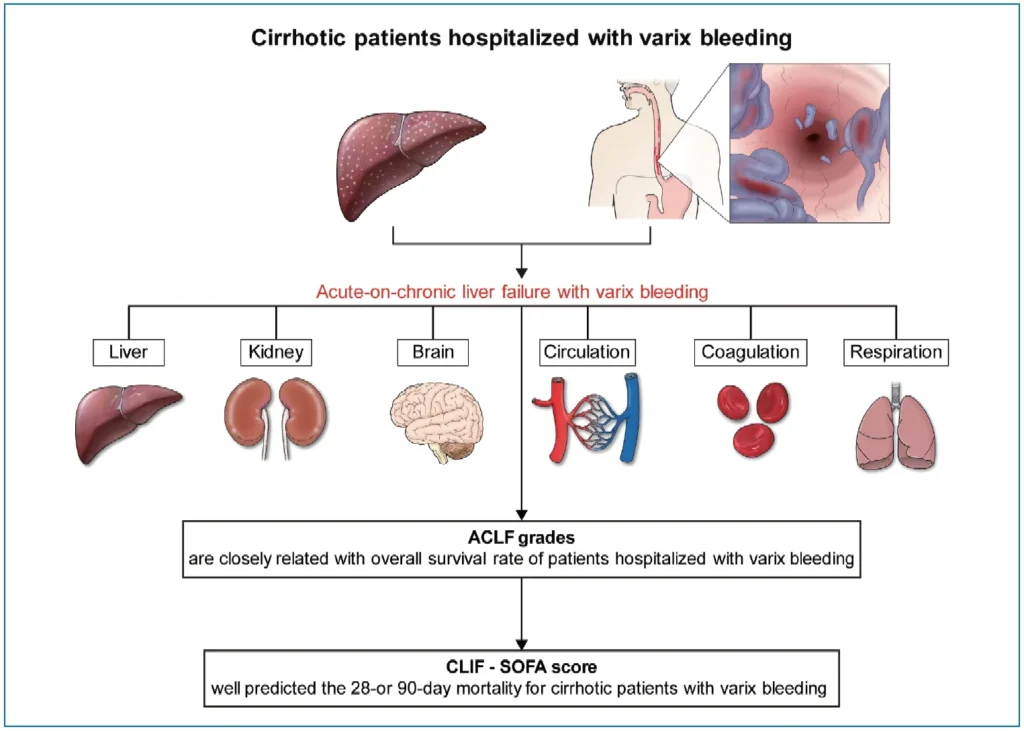

Acute-on-Chronic Liver Failure (ACLF) is one of the most time-critical presentations in hepatology. In patients with chronic liver disease, an acute precipitant — infection, alcohol, viral hepatitis, drugs, or an unknown trigger — causes rapid deterioration with one or more organ failures. Without the right subspecialty input within the first 48–72 hours, mortality at 28 days can exceed 50% in Grade 3 ACLF.
This article explains what ACLF is, how it is graded, what treatment looks like, and why subspecialty hepatologist input — not general physician or gastroenterology management — is essential.
What is ACLF?
ACLF is defined by the APASL (Asian Pacific Association for the Study of the Liver) as an acute hepatic insult manifesting as jaundice (serum bilirubin ≥5 mg/dL) and coagulopathy (INR ≥1.5) complicated within 4 weeks by clinical ascites and/or encephalopathy in a patient with previously diagnosed or undiagnosed chronic liver disease.
The APASL-AARC (ACLF Research Consortium) criteria, which Dr. Chetan Kalal has been directly involved in as part of AARC research, define three grades of ACLF based on the AARC score (0–15 points), which incorporates bilirubin, INR, creatinine, lactate, and hepatic encephalopathy grade.
- ACLF Grade 1 (AARC 5–7): 28-day mortality ~20–25%
- ACLF Grade 2 (AARC 8–10): 28-day mortality ~40–50%
- ACLF Grade 3 (AARC 11–15): 28-day mortality ~70–80% without transplant
Dr. Chetan Kalal is a contributing member of the APASL-AARC consortium — the group that developed and validated the AARC score and ACLF grading system used across Asia. His clinical practice and research are centred on ACLF management, outcomes, and transplant decision-making in ACLF.
Causes of ACLF — acute precipitants
In India and Asia, the most common precipitants of ACLF are:
- Bacterial infection (30–40%) — including SBP, pneumonia, UTI, bacteraemia
- Alcohol — acute alcoholic hepatitis superimposed on alcoholic cirrhosis
- Hepatitis B reactivation (particularly in HBsAg-positive patients who are immunosuppressed)
- Superimposed acute viral hepatitis A or E
- Drug-induced liver injury (DILI/HILI) — including herbal and Ayurvedic preparations
- Gastrointestinal bleeding
- Unknown precipitant — approximately 20–30% of cases
The underlying chronic liver disease is most commonly hepatitis B-related cirrhosis or alcoholic cirrhosis in the Indian population.
ACLF management — what subspecialty hepatology delivers
ACLF management requires rapid, coordinated, subspecialty-led care:
1. Precipitant identification and treatment
Empirical antibiotics for presumed infection, early source control, antiviral therapy for HBV reactivation (tenofovir or entecavir, started within 24 hours), and removal of hepatotoxic drugs. Misidentifying or missing the precipitant leads directly to failure of recovery.
2. Organ support
Renal replacement therapy for hepatorenal syndrome or intrinsic acute kidney injury. Vasopressors for septic shock. Ventilation for ACLF-related respiratory failure. Lactulose and rifaximin, terlipressin, and albumin infusions are the core medical armamentarium.
3. AARC score trajectory monitoring
The direction of AARC score change over 3–7 days is more prognostically important than the admission score. A declining AARC score indicates potential recovery; a rising or plateau score at Grade 2–3 indicates that transplant candidacy assessment must be initiated without further delay.
4. Transplant candidacy assessment
For ACLF Grade 2 and Grade 3, transplant candidacy should be evaluated in parallel with medical management — not sequentially. Patients with ACLF Grade 3 who are appropriate transplant candidates have significantly better outcomes with urgent LDLT. The window for successful transplantation in ACLF Grade 3 is narrow: approximately 7–14 days from peak deterioration.
ACLF Grade 3 without transplant carries 70–80% 28-day mortality. With urgent LDLT in carefully selected patients, survival approaches 60–70% at 1 year. The decision to list for transplant in the context of acute deterioration requires experienced subspecialty hepatology judgment — not general physician assessment.
Why a second opinion matters in ACLF
ACLF is frequently mismanaged in non-subspecialty settings because:
- Transplant candidacy is not assessed at the right time — it is deferred until the patient is too sick to operate
- The AARC score trajectory is not monitored — the clinical team waits for “improvement” without a defined threshold for switching to transplant pathway
- Grade 3 ACLF is managed medically without ever reaching a transplant centre
- The precipitant is incompletely treated (e.g., antibiotics stopped too early, HBV reactivation missed)
A subspecialty second opinion in ACLF — especially for Grade 2 or Grade 3 — can change the clinical trajectory. Dr. Kalal provides emergency ACLF second opinions, including virtual consultation for patients admitted elsewhere in India or internationally.
ACLF and liver transplant — the India context
India performs the majority of liver transplants in Asia as LDLT. For ACLF, LDLT has specific advantages over deceased donor transplantation: the timing can be controlled, and a healthy living donor liver is not subject to the ischaemic injury that deceased donor livers sustain. In well-selected ACLF patients, LDLT at an experienced Indian centre offers outcomes comparable to elective transplantation.
Dr. Chetan Kalal provides the complete physician pathway for ACLF-to-transplant: diagnosis and grading, AARC score monitoring, organ support, listing decision, donor candidacy assessment coordination, and post-transplant aftercare.
Frequently Asked Questions
What is the survival rate for ACLF in India?
Without liver transplant: Grade 1 ACLF has ~75–80% 28-day survival; Grade 2 approximately 50–60%; Grade 3 approximately 20–30%. With urgent LDLT in appropriate Grade 3 candidates at experienced centres, 1-year survival approaches 60–70%. Early subspecialty involvement significantly improves outcomes across all grades.
Who is the best ACLF specialist in Mumbai?
Dr. Chetan Kalal — DM (Hepatology), MD, MRCP (UK), First DM Hepatologist of Maharashtra — is an APASL-AARC consortium member and has published original research on ACLF outcomes and management. He practises at Gleneagles Hospital Mumbai with full LDLT capability.
Can ACLF be treated without a liver transplant?
Grade 1 and some Grade 2 ACLF can recover with aggressive medical management targeting the precipitant and supporting organ function. Grade 3 ACLF has extremely high mortality without transplantation. The key is early subspecialty assessment — not waiting to see if medical management will work before considering transplant.
How is ACLF different from acute liver failure?
Acute liver failure (ALF) occurs in a patient with no prior liver disease. ACLF occurs in a patient with pre-existing chronic liver disease. The management, prognosis, and transplant criteria differ. Both require urgent subspecialty hepatology input.
Can I get an ACLF second opinion virtually?
Yes. Dr. Kalal provides emergency virtual ACLF second opinions for patients admitted at other hospitals in India or internationally. Submit the AARC score parameters, organ function labs, imaging, and clinical summary. A rapid clinical direction response is provided. Book at drchetankalal.com/second-opinion.
Book a Consultation
In-person, Mumbai: Gleneagles Hospital — drchetankalal.com/book
ACLF second opinion (virtual, urgent): drchetankalal.com/second-opinion
Medical disclaimer: This article is for informational and educational purposes only. ACLF is a medical emergency. If you or a family member has suspected ACLF, attend the nearest emergency department immediately or call your treating hospital. This article does not substitute for direct clinical evaluation.
About the Author
Dr. Chetan Kalal — MBBS, MD (Internal Medicine), DM Hepatology (ILBS, New Delhi) — is the First DM Hepatologist of Maharashtra and Associate Director, Hepatology & Liver Transplant, at Gleneagles Hospital Mumbai. He has 26 peer-reviewed publications and serves on the APASL AARC Expert Panel. Fellow, National Academy of Medical Sciences (FNAMS). Learn more · Book appointment